An Open-Source, Elastomer Interconnection-based
Connector for Flexible Neural Interfaces






Mating Dynamics (left) and Structural Breakdown (right) of the E-Link(256)
🔬 Interactive 3D Model: E-Link Headstage Integration
🔬 E-Link – 3D Interactive View
🔬 256Ch Customized Headstage – 3D Interactive View
📖 Overview
E-Link (Elastomer Interconnection-based connector) is an open-source, miniature pedestal connector system based on elastomer interconnection. It provides a robust, scalable interface for High-Density Soft Neural Interfaces, specifically engineered for chronic applications in freely moving animals.

The system integrates two high-density PCBs, an anisotropic elastomeric contact interface, and a lightweight pedestal housing into a fully integrated, headstage-ready solution.
📊 Quick Specifications
⚙️ Assembly Pipeline
⚙️ Assembly & Validation Pipeline
The insertion-free "rotate-and-play" interface eliminates micro-alignment requirements, enabling reproducible assembly by untrained operators with consistent electrical performance.
Pedestal
Adapter PCB
Elastomer
Headstage
Threaded Cap
Verify
🧩 System Components
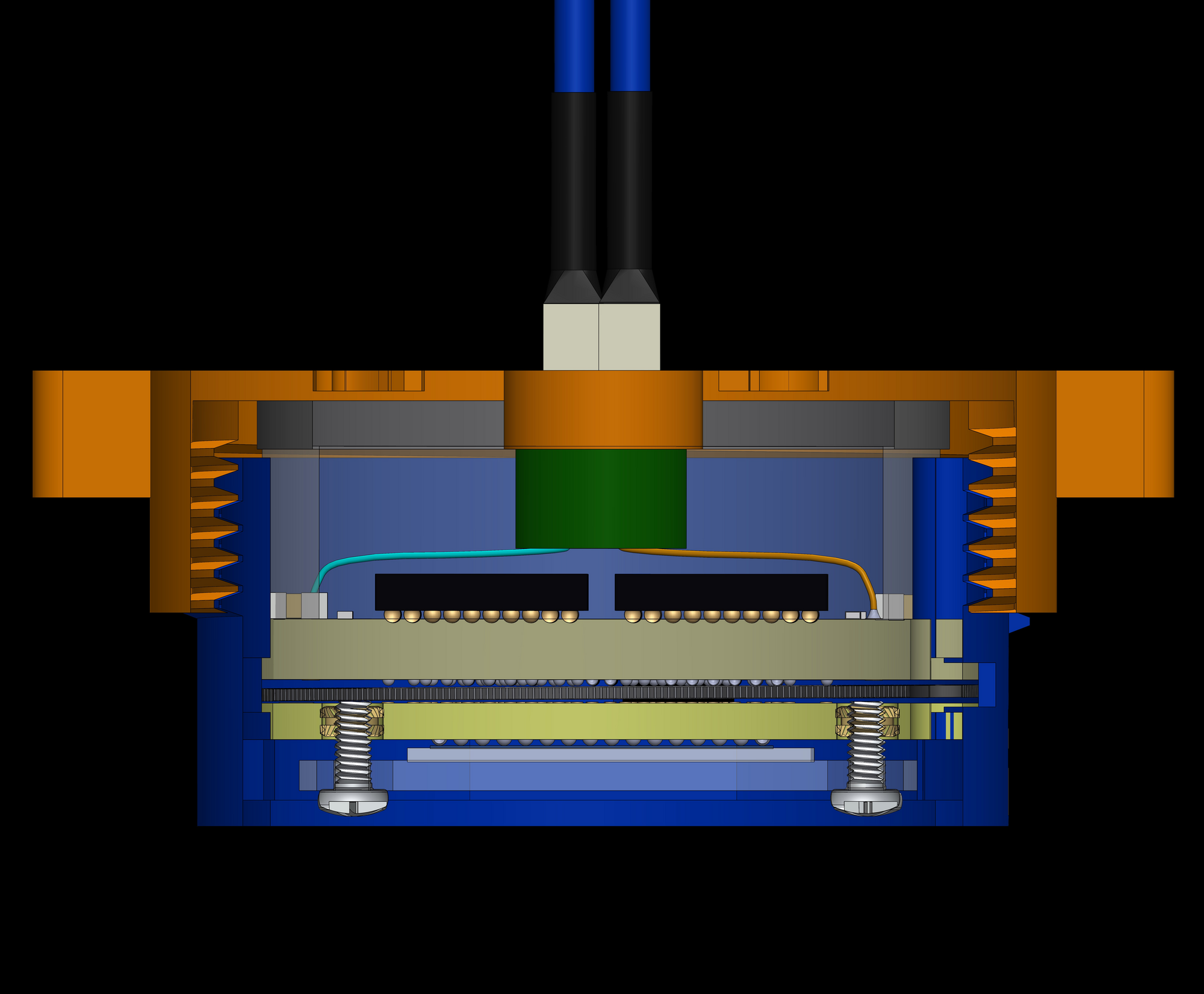
🔬 Interactive Cross-Section Explorer
Click any component below or hover directly on the cross-section to highlight the corresponding layer and view specifications.
 1
2
3
4
5
6
1. SPI Cables
2. Foam Washer
3. Threaded Cap
4. Headstage PCB
5. Elastomer
6. Adapter PCB
1
2
3
4
5
6
1. SPI Cables
2. Foam Washer
3. Threaded Cap
4. Headstage PCB
5. Elastomer
6. Adapter PCB
🔬 16×16 Spatial Impedance Mapping
Gold-film test interface validates uniform contact pressure distribution. The threaded housing converts manual torque into uniform axial pressure across the entire 25-mm footprint.
Conclusion: The mechanical connector interface achieves 100% connection fidelity.
✨ Key Features
🌍 Future Application Roadmap
2.8g Payload
6.6g Total
Multi-Array Scalable
🚀 Scalability Roadmap: Pathway to 1024 Channels
The inherent pitch advantage of anisotropic elastomeric technology enables massive channel scaling within the same 25-mm diameter footprint, without modifications to the mechanical compression housing.
-
⚡ 256-Channel High-Density & Scalable Interface
Compact pedestal footprint supporting 256-ch acquisition. The elastomer-based design offers a clear scaling roadmap (up to 1024-ch) without increasing physical size. -
🔌 Zero-Force "Soft" Interconnect
By replacing rigid pins with Anisotropic Conductive Elastomer, the system shifts from "insertion" to "compression," eliminating common "bent pin" failure modes. -
🎯 Self-Aligning & High Tolerance
Features high-precision mechanical guidance with "Structural Redundancy," naturally forgiving minor manual misalignments without microscopic assistance. -
🛠️ Modular Maintenance & On-Demand Assembly
Separable "Sandwich" structure allows independent replacement of damaged modules and supports on-demand chip soldering to save research costs. -
🪶 Detachable Active Electronics
Easily separate heavy electronics from the implanted pedestal during rest, leaving only a lightweight passive interface to promote natural animal behavior. -
🐭 Optimized for Chronic In-Vivo Research
Lightweight core (2.8g) and low-profile design compatible with commutators, ensuring robust long-term recording in freely moving animals. -
🧪 Surgical-Grade Integration
Textured sidewalls for superior adhesion and customizable base curvature to match specific cranial profiles, creating a rock-solid isolation chamber.

⚡ Representative Spike Signal Acquisition (Simulation)
An interactive simulation demonstrating the acquisition of extracellular action potentials (spikes). The signals are modeled within a standard spike-band filter (300 Hz – 7.5 kHz) at a 30 kS/s sampling rate, reflecting the expected waveform morphology, thermal noise floor, and signal-to-noise ratio (SNR) during high-density recordings with the E-Link system.
🛠 Bill of Materials (BOM) of the headstage

Assembled 256-Channel Headstage (Top View)

4-Layer Routing Structure (Top to Bottom)
👥 Developers and Lab
- Tianyu Bai (Lead Designer)
- Gen Li, Ph.D.
- Hui Fang, Ph.D.
-444444?style=flat-square&logoColor=white)
This project is developed by the MINE Lab at Dartmouth College.

📄 Publication
E-Link: A 256-ch Mini-Pedestal Connector for High-Density Soft Neural Interfaces
Author's Accepted Version. © 2026 IEEE. Personal use of this material is permitted. Permission from IEEE must be obtained for all other uses, including reprinting/republishing for advertising or promotional purposes, creating new collective works, for resale or redistribution, or reuse of any copyrighted component of this work in other works. The final published version is available via the DOI link above.
We welcome feedback and collaboration from the neuroengineering community!
- Inquiries: Thinking about using E-Link in your lab? We know setting up a new system can be tricky. If you have questions about the PCB design or 3D printing, drop us an email or open an issue — we’d love to help you get started!
- Support: support@ephys.tech
- Developer (Tianyu): tianyu@ephys.tech
📑 Citation & DOI
If you utilize these designs, code, or assets in your research, please cite this repository using the DOI:
T. Bai, G. Li, Y. Qi, and H. Fang, “E-Link: A 256-ch Mini-Pedestal Connector for High-Density Soft Neural Interfaces,” IEEE Journal on Flexible Electronics, 2026.

🔗 Repository & Downloads
This project is fully open-source under the MIT License. The complete design package — 3D-printable housing (STEP/STL) and PCB design files (native Altium Designer project) — is now publicly available. Click any card below to jump straight to the source files on GitHub.
🤝 Acknowledgments
The developers gratefully acknowledge support from the NIH (R01MH139342) and the Dartmouth PhD Innovation Fellowship.
Special thanks to the members of the MINE Lab and the Thayer School of Engineering for their technical support and feedback throughout the development of the E-Link (256) system.
📜 License
Copyright © 2026 Tianyu Bai
This project is open-source and available under the MIT License. Click the badge below for full license details.
👆 🇺🇸 English Version / 英文版 👆 👇 🇨🇳 Chinese Version / 中文版 👇
 易链
易链
一种基于弹性导电体互连技术的
高密度柔性神经接口连接器






E-Link易链(256) 的插拔动态(左)和结构分解(右)
🔬 E-Link :3D 交互式集成视图
🔬 E-Link 三维交互模型
🔬 256通道定制放大器 – 三维交互模型
📖 概览
E-Link易链,是一款基于弹性导电体互连技术(Elastomer Interconnection)的开源微型基座连接系统。它为柔性神经探针提供了稳固且可扩展的接口,专为自由活动动物的长期实验而优化设计
本连接器提供完全一体化的"即拧即用"数据采集方案。系统利用弹性导电介质连接高密度 PCB,并封装于轻量级基座中。最大的突破在于实现"零力插拔",从物理层面规避高密度引脚连接器常见的断针、弯针风险。
📊 规格参数
⚙️ 装配流程
⚙️ 装配与验证流程
免插拔的"旋转即用"接口设计消除了微米级对准的需求,使未经培训的操作者也能实现可重复的组装,并保持一致的电气性能。
基座
转接 PCB
弹性导电体
放大器板
螺纹顶盖
验证
🧩 系统组件
🔬 交互式截面结构浏览器
将鼠标悬停在截面结构图或点击下方任意组件,即可高亮对应层并查看详细规格。
1
2
3
4
5
6
1. SPI 线缆
2. 泡棉垫圈
3. 顶部螺纹盖
4. 放大器电路板
5. 弹性导电体
6. 转接电路板
🔬 16×16 接触阻抗空间映射
通过金膜测试接口验证了接触压力的均匀分布。螺纹外壳将手动扭矩转化为整个 25 mm 直径范围内均匀的轴向压力。
结论:本机械连接接口实现 100% 连接保真度,所有失效均源于头戴板 BGA 焊接工艺,与弹性体互连本身无关。
✨ 核心特性
🌍 跨物种适用性展望
2.8g 载荷
6.6g 共计
可拓展矩阵
🚀 通道拓展路线图:迈向 1024 通道
得益于各向异性弹性导电体的高密度间距优势,可在保持 25 mm 直径占地不变的前提下,实现通道数的大规模拓展,且无需对外壳压缩结构作任何改动。
-
⚡ 256通道高密度与可扩展接口
在有限基座占地面积内实现256通道数据采集。得益于弹性体互连的高集成度,该系统提供了清晰的扩展路径(可达1024通道),且不会增加额外的手术复杂度。 -
🔌 零插拔力,以柔克刚
利用各向异性导电弹性体取代传统刚性插针。通过“旋紧结构”将扭矩转化为均匀压力,从物理层面彻底规避了高密度连接器常见的断针、弯针等失效模式。 -
🎯 自对准与高容错连接
系统具备优异的机械限位与电气容错率。无需微米级精密对齐,只需简单旋紧即可实现稳定连接,极大降低了手动操作的难度和失败风险。 -
🛠️ 模块化维护与按需组装
采用“三明治”式分离结构(外壳、适配板、放大器板)。支持损坏模块的单独更换,并允许根据实验需求灵活焊接芯片,显著降低了科研成本。 -
🪶 电子模块即插即拆,释放头部负担
在非记录期间,有源电路可与底座快速分离,仅在颅骨留下极轻量的无源接口。这大幅减轻了动物的物理载荷,保障其在实验间隙的自然活动状态。 -
🐭 专为自由活动动物实验优化
核心组件仅重 2.8g。低剖面设计完美适配换向器 (Commutator),有效管理线缆并确保动物在长期慢性实验中的自然行为,提升动物福利。 -
🧪 手术级一体化与解剖结构适配
侧壁纹理增强了与牙科水泥的附着力。基座底部的打印弧度可根据不同动物头部曲线进行定制调整,实现完美贴合,构建出全封闭的防护舱。
⚡ 代表性 Spike 信号采集示意
本交互模块为模拟演示,展示了系统在标准 Spike 频段(300 Hz – 7.5 kHz)下的胞外动作电位采集能力。该模型以 30 kS/s 的采样率,直观呈现了使用 E-Link 系统进行高密度记录时预期的波形动力学特征、系统热噪声底噪以及信噪比 (SNR) 表现。
🛠 放大器物料清单 (BOM)
已组装的 256 通道前置放大器 (顶视图)
👥 开发者与实验室
- 白天宇 (主导研发及设计)
- 李根
- 方辉教授
-444444?style=flat-square&logoColor=white)
本项目由达特茅斯学院的 MINE Lab团队开发。

📄 出版物
E-Link: A 256-ch Mini-Pedestal Connector for High-Density Soft Neural Interfaces
作者接收版本 (Author's Accepted Version)。© 2026 IEEE. Personal use of this material is permitted. Permission from IEEE must be obtained for all other uses, including reprinting/republishing for advertising or promotional purposes, creating new collective works, for resale or redistribution, or reuse of any copyrighted component of this work in other works. 经 IEEE 排版的最终版本请通过上方 DOI 链接访问。
🤝 诚挚欢迎神经工程领域同行的反馈与合作!
- 技术咨询:有意在您的实验室部署 E-Link 易链?作为开发者,我们深知从零搭建一套新系统的种种挑战。无论您在 PCB 设计、3D 打印制造、还是系统组装方面遇到任何问题,欢迎随时通过邮件联系我们,将为您提供技术支持。
- 技术支持:support@ephys.tech
- 留言:tianyu@ephys.tech
📑 引用与 DOI
如在研究中使用了相关设计、代码或资产,请使用以下引用源:
当前引用源:
T. Bai, G. Li, Y. Qi and H. Fang, “E-Link: A 256-ch Mini-Pedestal Connector for High-Density Soft Neural Interfaces,” in IEEE Journal on Flexible Electronics, doi: 10.1109/JFLEX.2026.3692102.

🔗 仓库与下载
本项目完全开源。完整设计包——3D 打印外壳文件 (STEP/STL) 与 PCB 设计文件(Altium Designer 原生工程)——现已全部公开。点击下方任意卡片,即可一键跳转至 GitHub 上的源文件。
🤝 致谢
开发者感谢 美国国立卫生研究院 NIH R01MH139342 和 达特茅斯博士生创新奖学金 (Dartmouth PhD Innovation Fellowship) 的支持。
特别感谢 达特茅斯Thayer工学院 的相关成员在易链系统开发过程中提供的技术支持和反馈。
📜 许可协议
版权所有 © 2026 Tianyu Bai
本项目为开源硬件,在以下许可下可用。点击下方徽章查看完整许可详情。
- 硬件源文件 (KiCad/Gerbers/STL 文件):在 MIT 许可 下授权。
- 文档、原理图 (PDF) 和图像:在 CC BY 4.0 国际许可 下授权。